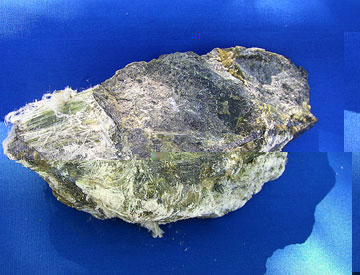
 Serpentine White Chrysotile, CAS No. 12001-29-5, is obtained from serpentinite rocks which are common throughout the world. Its idealized chemical formula is Mg3(Si2O5)(OH)4. Chrysotile fibers are curly as opposed to fibers from amosite, crocidolite, tremolite, actinolite, and anthophyllite which are needlelike. Chrysotile, along with other types of asbestos, has been banned in dozens of countries and is only allowed in the United States and Europe in very limited circumstances. Chrysotile has been used more than any other type and accounts for about 95% of the asbestos found in buildings in America.[7] Applications where chrysotile might be used include the use of joint compound. It is more flexible than amphibole types of asbestos; it can be spun and woven into fabric. The most common use is within corrugated asbestos cement roof sheets typically used for outbuildings, warehouses and garages. It is also found as flat sheets used for ceilings and sometimes for walls and floors. Numerous other items have been made containing chrysotile including brake linings, cloth behind fuses (for fire protection), pipe insulation, floor tiles, and rope seals for boilers. |
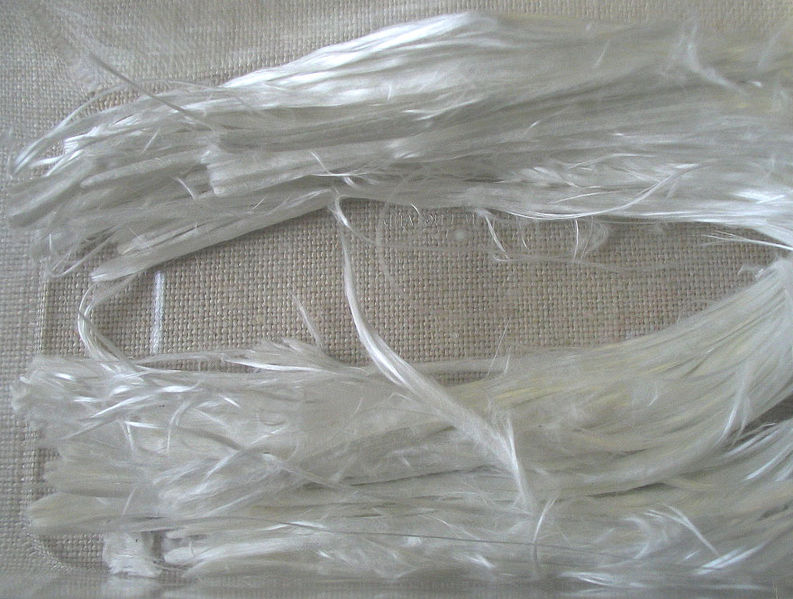 Amphibole Brown Amosite, CAS No. 12172-73-5, is a trade name for the amphiboles belonging to the Cummingtonite - Grunerite solid solution series, commonly from Africa, named as an acronym from Asbestos Mines of South Africa. One formula given for amosite is Fe7Si8O22(OH)2. It is found most frequently as a fire retardant in thermal insulation products and ceiling tiles. |
 Blue Crocidolite, CAS No. 12001-28-4 is an amphibole found primarily in southern Africa, but also in Australia. It is the fibrous form of the amphibole riebeckite. One formula given for crocidolite is Na2Fe2+3Fe3+2Si8O22(OH)2. Notes: chrysotile commonly occurs as soft friable fibers. Asbestiform amphibole may also occur as soft friable fibers but some varieties such as amosite are commonly straighter. All forms of asbestos are fibrillar in that they are composed of fibers with widths less than 1 micrometer that occur in bundles and have very long lengths. Asbestos with particularly fine fibers is also referred to as "amianthus". Amphiboles such as tremolite have a crystal structure containing strongly bonded ribbonlike silicate anion polymers that extend the length of the crystal. Serpentine (chrysotile) has a sheetlike silicate anion which is curved and which rolls up like a carpet to form the fiber. |
||
Six minerals are defined by the United States Environmental Protection Agency as "asbestos" including that belonging to the serpentine class chrysotile and that belonging to the amphibole class amosite, crocidolite, tremolite, anthophyllite and actinolite. There is an important distinction to be made between serpentine and amphibole asbestos due to differences in their chemical composition and their degree of potency as a health hazard when inhaled. However asbestos and all commercial forms of asbestos (including chrysotile asbestos) are known to be human carcinogens based on sufficient evidence of carcinogenicity in humans. Other materials Other regulated asbestos minerals, such as tremolite asbestos, CAS No. 77536-68-6, Ca2Mg5Si8O22(OH)2; actinolite asbestos, CAS No. 77536-66-4, Ca2(Mg, Fe)5(Si8O22)(OH)2; and anthophyllite asbestos, CAS No. 77536-67-5, (Mg, Fe)7Si8O22(OH)2; are less commonly used industrially but can still be found in a variety of construction materials and insulation materials and have been reported in the past to occur in a few consumer products. Other natural and not currently regulated asbestiform minerals, such as richterite, Na(CaNa)(Mg, Fe++)5(Si8O22)(OH)2, and winchite, (CaNa)Mg4(Al, Fe3+)(Si8O22)(OH)2, may be found as a contaminant in products such as the vermiculite containing zonolite insulation manufactured by W.R. Grace and Company. These minerals are thought to be no less harmful than tremolite, amosite, or crocidolite, but since they are not regulated, they are referred to as "asbestiform" rather than asbestos although may still be related to diseases and hazardous. Producing nations Asbestos output in 2007 In 2006, 2.3 million tons of asbestos were mined worldwide, in 11 or 12 countries. Russia was the largest producer with about 40.2% world share followed by China (19.9%), Kazakhstan (13.0%), Canada (10.3%), and Brazil (9.9%). Historic usage Asbestos was named by the ancient Greeks, although the naming of minerals was not very consistent at that time (the modern Greek word ἀσβεστος stands for lime, not for the material known as asbestos in English). The ancients already recognized certain hazards of the material. The Greek geographer Strabo and the Roman naturalist Pliny the Elder noted that the material damaged lungs of the slaves who mined it.[10] Charlemagne, the first Holy Roman Emperor, is said to have had a tablecloth made of asbestos.[11] Wealthy Persians, who bought asbestos imported over the Hindu Kush, amazed guests by cleaning the cloth by simply exposing it to fire. According to Biruni in his book of Gems, any cloths made of asbestos (Persian: آذرشست, āzarshast or Persian: آذرشب, āzarshab) were called (Persian: شستكه) shastakeh.[12] Some of the Persians believed the fiber was fur from an animal (named samandar, Persian: سمندر) that lived in fire and died when exposed to water.[13][14] While traveling to China, Marco Polo described observing miraculous garments that were cleaned by being placed in fires[citation needed]. These garments were likely made from asbestos[citation needed]. Some archeologists believe that ancients made shrouds of asbestos, wherein they burned the bodies of their kings, in order to preserve only their ashes, and prevent their being mixed with those of wood or other combustible materials commonly used in funeral pyres.[15] Others assert that the ancients used asbestos to make perpetual wicks for sepulchral or other lamps.[13] In more recent centuries, asbestos was indeed used for this purpose. Although asbestos causes skin to itch upon contact, ancient literature indicates that it was prescribed for diseases of the skin, and particularly for the itch. It is possible that they used the term asbestos for soapstone, because the two terms have often been confused throughout history.[15] Recent usage Asbestos became more widespread during the industrial revolution; in the 1866 it was used as insulation in the U.S. and Canada. Development of the first commercial asbestos mine began in 1874 in the Appalachian foothills of Quebec.[16] By the mid 20th century uses included fire retardant coatings, concrete, bricks, pipes and fireplace cement, heat, fire, and acid resistant gaskets, pipe insulation, ceiling insulation, fireproof drywall, flooring, roofing, lawn furniture, and drywall joint compound. Approximately 100,000 people in the United States have died, or will die, from asbestos exposure related to ship building. In the Hampton Roads area, a shipbuilding center, mesothelioma occurrence is seven times the national rate.[17] Thousands of tons of asbestos were used in World War II ships to wrap the pipes, line the boilers, and cover engine and turbine parts. There were approximately 4.3 million shipyard workers in the United States during WWII; for every thousand workers about fourteen died of mesothelioma and an unknown number died from asbestosis.[18] Asbestos fibers were once used in automobile brake pads, shoes, and clutch discs. Since the mid-1990s, a majority of brake pads, new or replacement, have been manufactured instead with linings made of ceramic, carbon, metallic and aramid fiber (Twaron or Kevlar—the same material used in bulletproof vests). Kent, the first filtered cigarette on the market, used crocidolite asbestos in its "Micronite" filter from 1952 to 1956.[19] The first documented death related to asbestos was in 1906. In the early 1900s researchers began to notice a large number of early deaths and lung problems in asbestos mining towns. The first diagnosis of asbestosis was made in the UK in 1924. By the 1930s, the UK regulated ventilation and made asbestosis an excusable work related disease, about ten years sooner than the U.S.[6] The term mesothelioma was first used in medical literature in 1931; its association with asbestos was first noted sometime in the 1940s. The United States government and asbestos industry have been criticized for not acting quickly enough to inform the public of dangers, and to reduce public exposure. In the late 1970s court documents proved that asbestos industry officials knew of asbestos dangers since the 1930s and had concealed them from the public.[18] A similar situation had arisen in the 1920s with the careless handling of radium and the ensuing scandal of the Radium Girls. In Japan, particularly after World War II, asbestos was used in the manufacture of ammonium sulfate for purposes of rice production, sprayed upon the ceilings, iron skeletons, and walls of railroad cars and buildings (during the 1960s), and used for energy efficiency reasons as well. Production of asbestos in Japan peaked in 1974 and went through ups and downs until about 1990, when production began to drop severely.[20] In Australia, asbestos was widely used in construction and other industries between 1945 and 1980. From the 1970s there was increasing concern about the dangers of asbestos and its use was phased out. Mining ceased in 1983. The use of asbestos was phased out in 1989 and banned entirely in 2004. The dangers of asbestos are now well known in Australia and there is help and support for sufferers from asbestosis or mesothelioma.[21] Specific products Serpentine group Serpentine minerals have a sheet or layered structure. Chrysotile is the only asbestos mineral in the serpentine group. In the United States, chrysotile has been the most commonly used type of asbestos. According to the U.S. EPA Asbestos Building Inspectors Manual, chrysotile accounts for approximately 95% of asbestos found in buildings in the United States. Chrysotile is often present in a wide variety of products and materials, including: drywall and joint compound plaster mud and texture coats vinyl floor tiles, sheeting, adhesives roofing tars, felts, siding, and shingles "transite" panels, siding, countertops, and pipes popcorn ceilings, also known as acoustic ceilings fireproofing caulk gaskets packing, a system for sealing a rotating shaft brake pads and shoes clutch plates stage curtains fire blankets interior fire doors fireproof clothing for firefighters thermal pipe insulation filters for removing fine particulates from chemicals, liquids, and wine dental cast linings HVAC flexible duct connectors drilling fluid additives A household heat spreader for cooking on gas stoves, made of asbestos (probably 1950s; "Amiante pur" is French for "Pure Asbestos") In the European Union and Australia it has recently been banned as a potential health hazard[22] and is not used at all. Japan is moving in the same direction, but more slowly. Revelations that hundreds of workers had died in Japan over the previous few decades from diseases related to asbestos sparked a scandal in mid-2005.[23] Tokyo had, in 1971, ordered companies handling asbestos to install ventilators and check health on a regular basis; however, the Japanese government did not ban crocidolite and amosite until 1995, and a full-fledged ban on asbestos was implemented in October 2004.[23] [edit]Amphibole group Five types of asbestos are found in the amphibole group: amosite, crocidolite, anthophyllite, tremolite, and actinolite. Amosite, the second most likely type to be found in buildings, according to the U.S. EPA Asbestos Building Inspectors Guide, is the "brown" asbestos. Amosite and crocidolite were formerly used in many products until the early 1980s. The use of all types of asbestos in the amphibole group was banned in much of the Western world by the mid-1980s, and by Japan in 1995. These products were mainly: Low density insulation board and ceiling tiles Asbestos-cement sheets and pipes for construction, casing for water and electrical/telecommunication services Thermal and chemical insulation (e.g., fire rated doors, limpet spray, lagging and gaskets) |
||||
