Asbestos Information |
||
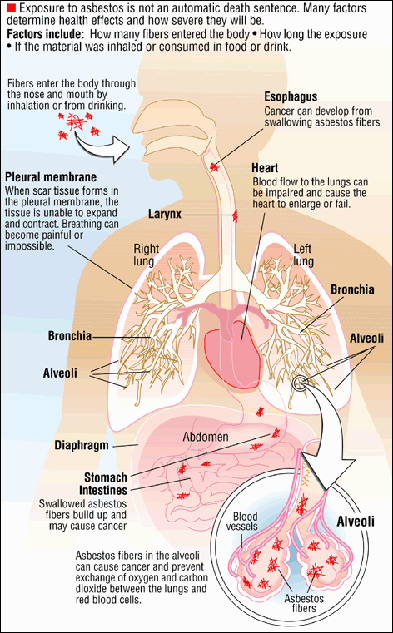 Six minerals are defined by the United States Environmental Protection Agency as "asbestos" including that belonging to the serpentine class chrysotile and that belonging to the amphibole class amosite, crocidolite, tremolite, anthophyllite and actinolite. There is an important distinction to be made between serpentine and amphibole asbestos due to differences in their chemical composition and their degree of potency as a health hazard when inhaled. However asbestos and all commercial forms of asbestos (including chrysotile asbestos) are known to be human carcinogens based on sufficient evidence of carcinogenicity in humans. |
Asbestos (from Greek ἄσβεστος meaning "unquenchable" or "inextinguishable") is a set of six naturally occurring silicate minerals exploited commercially for their desirable physical properties. They all have in common their asbestiform habit, long, (1:20) thin fibrous crystals. The inhalation of asbestos fibers can cause serious illnesses, including malignant lung cancer, mesothelioma (a formerly rare cancer strongly associated with exposure to amphibole asbestos), and asbestosis (a type of pneumoconiosis). Long term exposure to high concentrations of asbestos fibers is more likely to cause health problems, as asbestos exists in the ambient air at low levels, which itself does not cause health problems.[1] The European Union has banned all use of asbestos[2] and extraction, manufacture and processing of asbestos products.[3] Asbestos became increasingly popular among manufacturers and builders in the late 19th century because of its sound absorption, average tensile strength, and its resistance to heat, electrical and chemical damage. When asbestos is used for its resistance to fire or heat, the fibers are often mixed with cement or woven into fabric or mats. Asbestos was used in some products for its heat resistance, and in the past was used on electric oven and hotplate wiring for its electrical insulation at elevated temperature, and in buildings for its flame-retardant and insulating properties, tensile strength, flexibility, and resistance to chemicals. |
|
